Love that affordable scooter? But when that smooth ride turns into a screeching mess, the experience doesn’t feel so gratifying anymore. Like every other electronic vehicle, your e-scooter also needs occasional maintenance. And knowing how to change your e-scooter brake pads can be quite convenient.
If your scooter’s been showing signs of wear, like reduced stopping power, grinding noise when you hit the brakes, or vibrating brake levers, it might be time for a brake pad replacement.
Good news: it is easy to learn how to change e scooter brake pads.
But First: When Do You Really Need New Brake Pads?
Understand whether your e-scooter even needs new brake pads before you get your tools out. The disc or foot brakes of most budget versions (such as GOTRAX or NAVIC) show common signs of wear, which can be used as an indication for a replacement.
Essentially, it is time for new pads if you notice:
- Squealing or Scraping: The classic sign is a high-pitched squeal; metal scraping indicates that they are totally worn out.
- Reduced Stopping Power: When you are pulling the lever much harder and stopping more slowly, it indicates that the brakes are too thin.
- Obvious Thinning: Look at the caliper. Compare the thickness of the pads to a credit card. If the former is thinner, you may need a change.
It is always worth keeping an eye on your e scooter brake pads to make sure that your daily ride doesn’t put you in an unprecedented emergency.
Step-by-Step: How to Change E-Scooter Brake Pads
Alright, let’s get to it. You’ll need a few basic tools to change e-scooter brake pads.
What You’ll Need:
- Your new brake pads (more on that below).
- A general Allen wrench set (typically 2mm, 2.5mm, or 3mm).
- A flathead screwdriver (not compulsory, but it’s good to have a suitable tool to pry out the existing brake pads).
- A glove or rag (to prevent the oils from your skin getting on the new rotors).
Step 1: Remove the Wheel
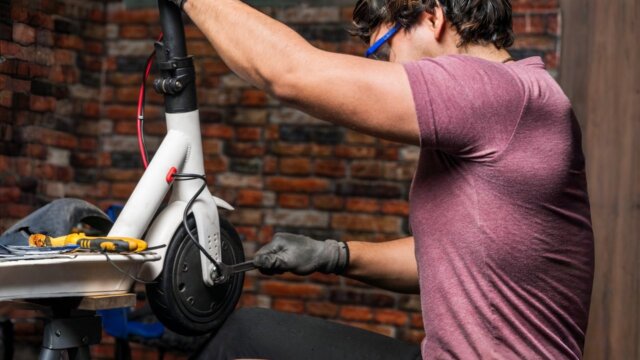
An effective way of getting to the brake caliper without complications is to take the wheel off. Unscrew the axle bolts on the side of the scooter on which the brake is situated. You can do this with an Allen wrench. Slide out the fork wheel carefully. Wires do not have to be pulled off; all you have to do is rest the scooter body on a slightly heightened spot, a box, or a step, to make the wheel easily accessible.
Step 2: Pop Out the Old Pads
Find the brake caliper (a metal clamp that is mounted on top of the disc). On each side of the disc, there will be two pads. They are normally secured in place with a bolt or a pin. Take out the pin/bolt, and the pads will automatically come out. If they’re stuck in, try prying them out with a screwdriver.
Step 3: Insert Your New Brake Pads
Now comes the satisfying part. Install the new brake pads on the e-scooter and fix them into the caliper. Make sure that the metal plate is facing outwards and the frictional surface faces the disc. Lock them in with the pin.
For reliable stopping power, we recommend using durable semi metallic disc brake pads. For a stronger grip, the Kugoo M4 Pro Compatible brake pads are a great pick. Both work with most commuter e scooters.
Step 4: Re-align and Reassemble
Squeeze the brake lever before putting in the wheel again, just to position the new pads around the disc. Next, push the wheel back in its place. Install the axle bolts, but avoid over-tightening them. Turn the wheel around to ensure that it turns freely without dragging the brake pads.
Now you can ride with absolute confidence without worrying about how to change e-scooter brake pads. If you’re looking for good-quality e-scooter brake pads that last, check out the listings here.
Conclusion
And that’s how you change your e-scooter brake pads! It’s simple, quick, and effortless with the right guidelines and tools. If your e-scooter brake pads are giving up, no need to stress about it. The finest rides, from Gotrax to Segway, also need fresh pads after long-term use. Thankfully, you can replace them yourself following the process outlined above.